
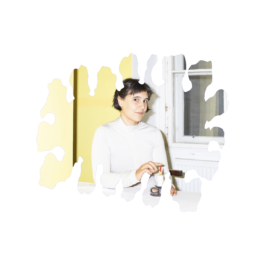
•Sophie Allerding• (she/they) is an interdisciplinary artist interested in how narratives shape reality, who gets to tell them, and who or what is excluded from dominant histories. Their practice centers on play and speculative storytelling as tools for imagining other realities and desirable futures. Sophie’s work bridges visual art and social practice, often taking the form of interactive installations, audiovisual works, participatory experiences, and LARP, inviting audiences to step into alternative realities.
With a migration background from Abya Yala, Sophie’s practice is informed by animism, and magical realism and it is her artistic mission to bridge the different worlds she inhabits. Her fictional worlds serve as critical tools for re-imagining our relationships with each other, with our environment, and with the systems of power that surround us. In doing so, Sophie aims to open space for marginalized ways of knowing and relating, based on connection and care.
Sophie is an active member of the feminist collectives
Possy (Hamburg) and Radio Echo Collective and is part of .zip, an artist-run interdisciplinary project space in Rotterdam.
Please enquire for extended version of the portfolio or download CV.
Sophie’s work was presented among other sites in the Deichtorhallen Museum for Photography (DE), Landesmuseum Koblenz (DE) Hallo: Radiofestival X-Kanal (DE), the Climate Utopias Festival (FI), Nederlands Fotomuseum (NL) Goethe Institut Vietnam (VNM) Transmission Radio Art festival (DE) and Climate Art Fest (DE) and Centro de la Imagen (MX), Städtische Galerie Karlsruhe (DE) and Het Nieuwe Instituut, Rotterdam (NL).
Friends and collaborators
This is an ongoing and continuously expanding list of peers I have collaborated with or who are otherwise connected to my practice. If you are interested in my work, you might also want to explore the work of these people. Please let me know if you notice anyone missing from this list.
Louisa Teichmann is a frequent collaborator who shares my interest in play. Together, we organize play-test sessions called Playground at .zip.
.zip currently hosts my practice, providing immense support and inspiration. I am grateful to be part of this community alongside Roos Groothuizen, Cyanne van den Houten, Ymer Marinus, Erik Peters, Louisa Teichmann, Charlotte Brand, Remco Akkerman, and Ginevra Petrozzi.
Lina van Jaruntowski is an artistic researcher and designer who often supports me by thinking along with my projects.
Ari Adamski is an artist and choreographer with whom I have created various participatory events.
Lucila Pacheco Dehne, a childhood friend and collaborator, has been instrumental in embracing next-level feminist world-building.
Noemi Biro and Pleun Gremmen are both media artists and TouchDesigner wizards. Together, we created a magic mirror.
Jana Romanova is an artist with whom I have created and played LARPs.
Ana Garcia Jácome is a visual artist with whom I collaborated on research for the Anatomical Theatre.
Daniel Siegersma is a constant source of inspiration and exchange. He also reviews almost all of my applications.
Amy Gowen from HumDrumPress provides excellent editorial and proofreading support, including for the publication of The Politics of Knowledge research group.
My peers in the feminist collectives Possy and Radio Echo continuously support and inspire me connecting feminist activism and art and cultures.
This website was designed by Saskia van der Meer.
The fonts in use are TorreFarfan by Estefania Gonzalez Sanchez and Isobare by Clemence Fontaine.
•Sophie Allerding• (she/they) is an interdisciplinary artist interested in how narratives shape reality, who gets to tell them, and who or what is excluded from dominant histories. Their practice centers on play and speculative storytelling as tools for imagining other realities and desirable futures. Sophie’s work bridges visual art and social practice, often taking the form of interactive installations, audiovisual works, participatory experiences, and LARP, inviting audiences to step into alternative realities.
With a migration background from Abya Yala, Sophie’s practice is informed by animism, and magical realism and it is her artistic mission to bridge the different worlds she inhabits. Her fictional worlds serve as critical tools for re-imagining our relationships with each other, with our environment, and with the systems of power that surround us. In doing so, Sophie aims to open space for marginalized ways of knowing and relating, based on connection and care.
Sophie is an active member of the feminist collectives
Possy (Hamburg) and Radio Echo Collective and is part of .zip, an artist-run interdisciplinary project space in Rotterdam.

Please enquire for extended version of the portfolio or download CV.
Sophie’s work was presented among other sites in the Deichtorhallen Museum for Photography (DE), Landesmuseum Koblenz (DE) Hallo: Radiofestival X-Kanal (DE), the Climate Utopias Festival (FI), Nederlands Fotomuseum (NL) Goethe Institut Vietnam (VNM) Transmission Radio Art festival (DE) and Climate Art Fest (DE) and Centro de la Imagen (MX), Städtische Galerie Karlsruhe (DE) and Het Nieuwe Instituut, Rotterdam (NL).
Friends and collaborators
This is an ongoing and continuously expanding list of peers I have collaborated with or who are otherwise connected to my practice. If you are interested in my work, you might also want to explore the work of these people. Please let me know if you notice anyone missing from this list.
Louisa Teichmann is a frequent collaborator who shares my interest in play. Together, we organize play-test sessions called Playground at .zip.
.zip currently hosts my practice, providing immense support and inspiration. I am grateful to be part of this community alongside Roos Groothuizen, Cyanne van den Houten, Ymer Marinus, Erik Peters, Louisa Teichmann, Charlotte Brand, Remco Akkerman, and Ginevra Petrozzi.
Lina van Jaruntowski is an artistic researcher and designer who often supports me by thinking along with my projects.
Ari Adamski is an artist and choreographer with whom I have created various participatory events.
Lucila Pacheco Dehne, a childhood friend and collaborator, has been instrumental in embracing next-level feminist world-building.
Noemi Biro and Pleun Gremmen are both media artists and TouchDesigner wizards. Together, we created a magic mirror.
Jana Romanova is an artist with whom I have created and played LARPs.
Ana Garcia Jácome is a visual artist with whom I collaborated on research for the Anatomical Theatre.
Daniel Siegersma is a constant source of inspiration and exchange. He also reviews almost all of my applications.
Amy Gowen from HumDrumPress provides excellent editorial and proofreading support, including for the publication of The Politics of Knowledge research group.
My peers in the feminist collectives Possy and Radio Echo continuously support and inspire me connecting feminist activism and art and cultures.
This website was designed by Saskia van der Meer.
The fonts in use are TorreFarfan by Estefania Gonzalez Sanchez and Isobare by Clemence Fontaine.
Songs for the Renewal is a ritualistic site consisting of six indoor fountains, each displaying a urinating female human-like figure and a set of whistles, water whistles, and other ritualistic vessels and instruments. The fountains are interactive and sound-triggered, each attuned and activated by a different whistle. The ritual surrounding these objects is known to have been performed for renewals. However, the exact nature of the ritual remains unclear, inviting the audience to speculate and participate by playing with the instruments.
Songs for the Renewal is the culmination of my long-term research on the representation and taboos surrounding female bodies in Western art history, as well as the intersection of the exploitation of nature and women's rights. My interest in gender and urination also considers the ecological impact, from harvesting hormones through farming pregnant mares to environmental hormonal pollution (so-called feminization of the environment), which leads to fertility issues in many species and contributes to a broader alienation from natural bodily functions and the environment.
To address the various stories, concerns, and facts gathered in my theoretical research, I have crafted a speculative fiction: a future where hormonal pollution has reached such extremes that an overload of estrogen has dissolved traditional genders, making all species rather feminine. Human societies remaining in this world have evolved distinct cultures, technologies, and beliefs from our own. In their cosmology, the world was created by seven sisters who sat to relieve themselves, and from their streams of urine, their world emerged.
The six fountains in Songs for the Renewal depict the seven sisters, and the ritualistic site serves as a sanctuary for performing rituals such as renewing relationships and reciprocity with the cosmos. Drawing from today's world as a starting point, this future reimagines gender roles and bodily fluids, turning the artifacts of Songs for the Renewal into souvenirs of a possible alternative reality.
Songs for the Renewal is a ritualistic site consisting of six indoor fountains, each displaying a urinating female human-like figure and a set of whistles, water whistles, and other ritualistic vessels and instruments. The fountains are interactive and sound-triggered, each attuned and activated by a different whistle. The ritual surrounding these objects is known to have been performed for renewals. However, the exact nature of the ritual remains unclear, inviting the audience to speculate and participate by playing with the instruments.
Songs for the Renewal is the culmination of my long-term research on the representation and taboos surrounding female bodies in Western art history, as well as the intersection of the exploitation of nature and women's rights. My interest in gender and urination also considers the ecological impact, from harvesting hormones through farming pregnant mares to environmental hormonal pollution (so-called feminization of the environment), which leads to fertility issues in many species and contributes to a broader alienation from natural bodily functions and the environment.
To address the various stories, concerns, and facts gathered in my theoretical research, I have crafted a speculative fiction: a future where hormonal pollution has reached such extremes that an overload of estrogen has dissolved traditional genders, making all species rather feminine. Human societies remaining in this world have evolved distinct cultures, technologies, and beliefs from our own. In their cosmology, the world was created by seven sisters who sat to relieve themselves, and from their streams of urine, their world emerged.
The six fountains in Songs for the Renewal depict the seven sisters, and the ritualistic site serves as a sanctuary for performing rituals such as renewing relationships and reciprocity with the cosmos. Drawing from today's world as a starting point, this future reimagines gender roles and bodily fluids, turning the artifacts of Songs for the Renewal into souvenirs of a possible alternative reality.
In the 15th century, a flood breached the Markermeer dykes in the Netherlands and washed an unknown body ashore. The creature appeared like a woman but couldn’t speak nor behave like a human being. Experts declared: It must be a mermaid.
Waterland – On How to Become a Body of Water is a climate fiction narrative about rising sea levels told from the perspective of a mermaid. In this work, I address our alienated relationship with the ocean, the entanglement of gender and ecology, and the urgency of imagining collective futures in the face of the climate crisis. The work consists of photographs, analogue double exposures, newspaper clippings, and photo montages, mostly presented as an installation. The project originated from a collaboration with the Foundation for Environmental and Spatial Planning Advice (STAB), based in the Netherlands. During this project, they were working on the restoration of the Markermeer dykes, built in response to rising sea levels. The restoration generated conflict as many in Dutch society did not consider it necessary, signalling the difficulties of effectively communicating the urgency of climate change.
My project Waterland is inspired by the Dutch folklore of the Zeemeermin from Edam, an imprisoned mermaid who appeared after a flood behind the Markermeer dikes in the 15th century. Her story of entrapment, public exhibition, and subsequent enslavement is exemplary of the modern Western approach to the environment, which prioritises profit and extraction over curiosity and respect - a worldview that objectifies nature. Some of the images represent the mermaid’s gaze, decentering the human perspective on the issue. Others show the mermaid navigating the human-made world using performance through staging. Playing with authority newspaper clipping conjure, I also blend historical legends with contemporary issues faced by Dutch society and present a fictional future pointing to the possibility of coexistence between humans and ocean life.
Astrida Neimanis' Essay On How to Become A Body of Water was a big inspiration for this work, and I have dedicated the subtitle of my work to it.
Installation shots: Climate Utopias Festival, Lahti, Finland 2021.
Read more about Waterland at Zero Nine Magazine.
In the 15th century, a flood breached the Markermeer dykes in the Netherlands and washed an unknown body ashore. The creature appeared like a woman but couldn’t speak nor behave like a human being. Experts declared: It must be a mermaid.
Waterland – On How to Become a Body of Water is a climate fiction narrative about rising sea levels told from the perspective of a mermaid. In this work, I address our alienated relationship with the ocean, the entanglement of gender and ecology, and the urgency of imagining collective futures in the face of the climate crisis. The work consists of photographs, analogue double exposures, newspaper clippings, and photo montages, mostly presented as an installation. The project originated from a collaboration with the Foundation for Environmental and Spatial Planning Advice (STAB), based in the Netherlands. During this project, they were working on the restoration of the Markermeer dykes, built in response to rising sea levels. The restoration generated conflict as many in Dutch society did not consider it necessary, signalling the difficulties of effectively communicating the urgency of climate change.
My project Waterland is inspired by the Dutch folklore of the Zeemeermin from Edam, an imprisoned mermaid who appeared after a flood behind the Markermeer dikes in the 15th century. Her story of entrapment, public exhibition, and subsequent enslavement is exemplary of the modern Western approach to the environment, which prioritises profit and extraction over curiosity and respect - a worldview that objectifies nature. Some of the images represent the mermaid’s gaze, decentering the human perspective on the issue. Others show the mermaid navigating the human-made world using performance through staging. Playing with authority newspaper clipping conjure, I also blend historical legends with contemporary issues faced by Dutch society and present a fictional future pointing to the possibility of coexistence between humans and ocean life.
Astrida Neimanis' Essay On How to Become A Body of Water was a big inspiration for this work, and I have dedicated the subtitle of my work to it.
Installation shots: Climate Utopias Festival, Lahti, Finland 2021.
Read more about Waterland at Zero Nine Magazine.
Glowing Eyes is about myths from the Brazilian Amazon rainforest, stories, that show humans as part of their environment and thus offer different perspectives than the Western concept of nature, where the human is seen as counterpart to it.
Myths have a great influence on how we perceive our environment, and move and act in it. The Amazonian Myths are part of the ecosystem of the forest, where they are alive, their storytellers tend to live in balance and respect with their environment. In contract to it colonialist created myths that show nature as wild which needs to be tamed to legitimize exploitation and degradation.
Due to my Latin American background I grew up with Brazilian folklore, it is part of my inner life. At the same time, I grew up in Germany, so that I also embody the western gaze which sees a tropical paradise of resources. To reestablish and heal a connection with nature, I look into the living myths to lead me. Through a visual and physical exploration, I reconnect to the stories of the Amazons to conjure up old images again and charge them with new magic.
This work emerged from research conducted during extended stays and workshops in Ribeirinho communities on Ilha de Marajó, Belém, Brazil.
Installation shots: Dior Visual Arts Award, Luma, Arles, France, 2021.
Glowing Eyes, solo show, Studio 45, Hamburg, 2020.
Read more about Glowing Eyes at PH Museum
Glowing Eyes is about myths from the Brazilian Amazon rainforest, stories, that show humans as part of their environment and thus offer different perspectives than the Western concept of nature, where the human is seen as counterpart to it.
Myths have a great influence on how we perceive our environment, and move and act in it. The Amazonian Myths are part of the ecosystem of the forest, where they are alive, their storytellers tend to live in balance and respect with their environment. In contract to it colonialist created myths that show nature as wild which needs to be tamed to legitimize exploitation and degradation.
Due to my Latin American background I grew up with Brazilian folklore, it is part of my inner life. At the same time, I grew up in Germany, so that I also embody the western gaze which sees a tropical paradise of resources. To reestablish and heal a connection with nature, I look into the living myths to lead me. Through a visual and physical exploration, I reconnect to the stories of the Amazons to conjure up old images again and charge them with new magic.
This work emerged from research conducted during extended stays and workshops in Ribeirinho communities on Ilha de Marajó, Belém, Brazil.
Installation shots: Dior Visual Arts Award, Luma, Arles, France, 2021.
Glowing Eyes, solo show, Studio 45, Hamburg, 2020.
Read more about Glowing Eyes at PH Museum
Letting piss run free is a privilege most womxn in this world do not have.
The image of the urinating woman is not one that belongs into public, in addition, the sexualisation of the femxle body also makes it a dangerous risk in some places. Womxn have to hide, go off the beaten track and sometimes hold back until it is dark enough to relieve themselves.
Under the working title Ways of Peeing, I am developing a work that examines the urinating female body. In doing so, I aim to address the representation and taboos surrounding female bodies within the history of Western art. My interest in gender and urination includes the ecological impact of urinating women, ranging from hormonal pollution to the alienation from natural bodily functions and our physical selves.
Ways of peeing is a visual liberation and a piss on the impossibility of the restrictive conditions that surround us.
Letting piss run free is a privilege most womxn in this world do not have.
The image of the urinating woman is not one that belongs into public, in addition, the sexualisation of the femxle body also makes it a dangerous risk in some places. Womxn have to hide, go off the beaten track and sometimes hold back until it is dark enough to relieve themselves.
Under the working title Ways of Peeing, I am developing a work that examines the urinating female body. In doing so, I aim to address the representation and taboos surrounding female bodies within the history of Western art. My interest in gender and urination includes the ecological impact of urinating women, ranging from hormonal pollution to the alienation from natural bodily functions and our physical selves.
Ways of peeing is a visual liberation and a piss on the impossibility of the restrictive conditions that surround us.
The Anatomical Theatre explores the link between the male and medical gaze, uncovering how female bodies have been constructed through capitalism, “modern” science, and Christianity—framed by beauty, sexuality, and reproductive labor.
Using the darkroom as a metaphorical uterus, I create layered anatomies that depict inner landscapes rather than idealized forms. Inspired by the origins of Western anatomical science, particularly the fetishized Anatomical Venus—the first anatomical wax model—the work highlights the historical transformation of bodies into fragmented objects of male fascination.
Organs without a body, science generating magic, a darkroom instead of a womb: The Anatomical Theatre is a speculative exploration of female anatomy, created with the tools available to us in the domestic space, given to us to modify our bodies. Against the reduction of bodies to isolated organs and tissues, this imagery aims to depict the inner landscape of emotions, layering physical representations of historical and political violence with the subjective experience of embodiment. Sculpturally expanded through wax figures, these works highlight the possibilities and fragility of molding the body while engaging the senses with the natural odours of beeswax and burnt wick.
This work is the outcome of a collaborative research project with Mexican artist and disabled justice activist Ana Garcia Jacome. This mixed-media installation combines analogue black-and-white photomontages, wax sculptures, and Jácome’s video work, Votive Offerings.
Installation view: Städtische Galerie Karlsruhe, Germany
Centro de la Imagen, Mexico City, Mexico
The Anatomical Theatre explores the link between the male and medical gaze, uncovering how female bodies have been constructed through capitalism, “modern” science, and Christianity—framed by beauty, sexuality, and reproductive labor.
Using the darkroom as a metaphorical uterus, I create layered anatomies that depict inner landscapes rather than idealized forms. Inspired by the origins of Western anatomical science, particularly the fetishized Anatomical Venus—the first anatomical wax model—the work highlights the historical transformation of bodies into fragmented objects of male fascination.
Organs without a body, science generating magic, a darkroom instead of a womb: The Anatomical Theatre is a speculative exploration of female anatomy, created with the tools available to us in the domestic space, given to us to modify our bodies. Against the reduction of bodies to isolated organs and tissues, this imagery aims to depict the inner landscape of emotions, layering physical representations of historical and political violence with the subjective experience of embodiment. Sculpturally expanded through wax figures, these works highlight the possibilities and fragility of molding the body while engaging the senses with the natural odours of beeswax and burnt wick.
This work is the outcome of a collaborative research project with Mexican artist and disabled justice activist Ana Garcia Jacome. This mixed-media installation combines analogue black-and-white photomontages, wax sculptures, and Jácome’s video work, Votive Offerings.
Installation view: Städtische Galerie Karlsruhe, Germany
Centro de la Imagen, Mexico City, Mexico